
The Neuropathy Tracker is a smartphone app for scientific studies of neuropathy – nerve damage in the feet and legs. It guides study participants step by step through a set of self-administered sensory and motor tests at home, using only the phone and a safety pin, and sends their answers to CARP for scientific analysis.
About the App
Peripheral neuropathy is a common complication of diabetes and cancer treatment, causing numbness, tingling, pain, or weakness in the feet and legs. Detecting and following it early is important, for example to prevent diabetic foot ulcers. Today, this requires a clinical examination by trained staff using special tools, which means waiting time and hospital visits.
The Neuropathy Tracker turns this examination into a self-test that study participants can do at home. It is based on established clinical methods – mainly the Utah Early Neuropathy Scale (UENS), combined with elements from the Total Neuropathy Score (TNS) and the DN4 pain questionnaire – adapted so they can be done at home with common household items. For example, the phone’s own vibration replaces the tuning fork used in the clinic.
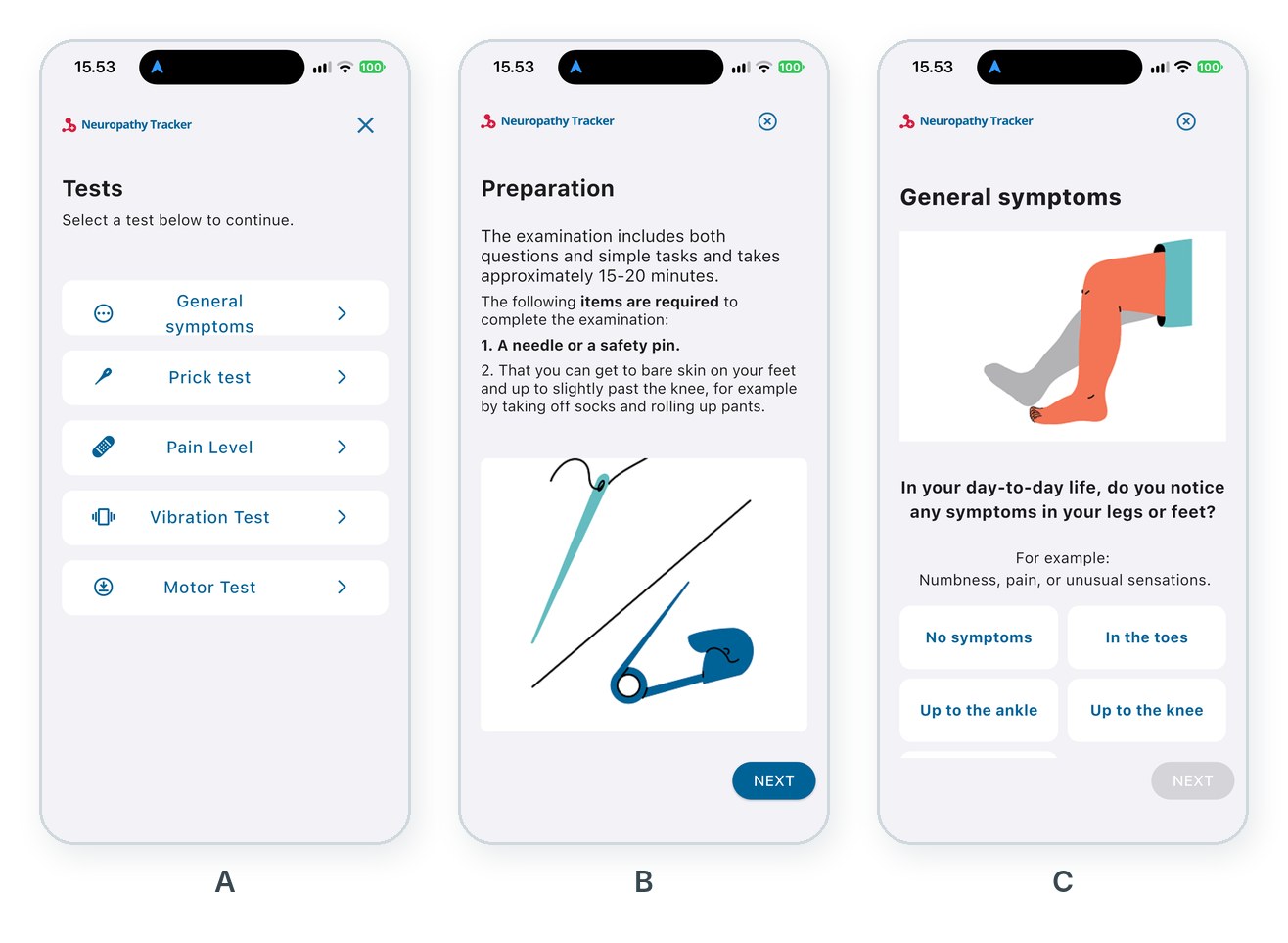
The Tests
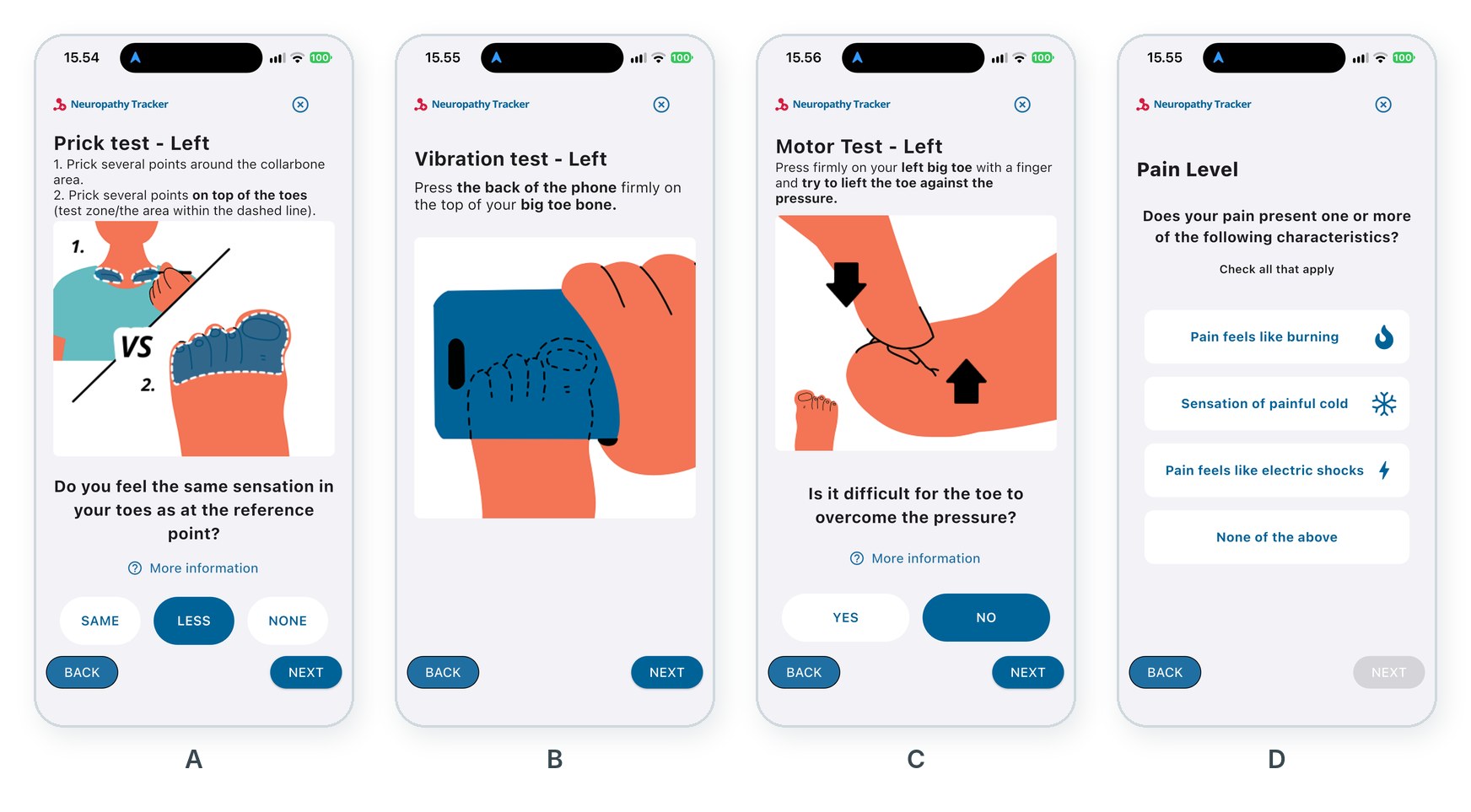
The examination takes about 15 to 20 minutes and consists of the tests in Table 1. Each test starts with an instruction page, and the illustrations show exactly which leg and which area to test. A “More information” button explains each step in more detail.
| Test | What the participant does | What is used |
|---|---|---|
| General symptoms | Reports whether there are symptoms such as numbness or tingling in the legs, and how far up they reach | Questionnaire |
| Pin-prick sensation | Pricks six areas on each leg with a safety pin and compares the feeling with a reference area at the collarbone | Safety pin |
| Painful touch | Reports whether touching or pricking the toes and feet is painful (allodynia and hyperalgesia) | Finger and safety pin |
| Vibration and joint sense | Holds the phone against three points on each leg and reports whether the vibration can be felt; checks the feeling of moving the big toe | The phone’s vibration; finger (big toe) |
| Muscle strength | Presses down on the big toe with a finger and tries to lift the toe against the pressure | Finger |
| Neuropathic pain | Rates the pain level and answers questions about what the pain feels like | Slider and questionnaire |
When the examination is done, the app confirms that it has been completed and uploaded to CARP. Participants can view their own answers as entered, but the app does not calculate or show any score, interpretation, or advice. Scoring is done only by the researchers as part of the scientific analysis of the study data, and results are not returned to participants or clinicians.
Research Use
The Neuropathy Tracker is used only for scientific research. The app can only be used after the participant has been invited to a study and has logged in through a CARP study deployment. Each examination is time-stamped, linked to the participant’s pseudonymous study ID, and uploaded to CARP, where the data are accessible only to the authorized researchers in the study. The app does not provide diagnosis or health advice, and the data are analyzed at group level for scientific purposes only.
Get the App
The Neuropathy Tracker is available in English and Danish on the App Store (iOS) and Google Play (Android). Note that the app can only be used by participants who have been invited to a study, and that it does not provide diagnosis or health advice. See also our post on the release of the app.
Evaluation
- Design and feasibility (2025): The app was designed together with neurologists, patients, and healthy volunteers in three design rounds. In a feasibility study with 17 patients at the Department of Neurology at Zealand University Hospital, all patients could complete the self-test without help, and the score computed from the app data correlated strongly with a clinical assessment by a trained examiner (r = 0.86) (Bardram et al., 2025). See also our post on the paper.
- Clinical validation (2025): A larger validation study found that the app agrees well with the clinical UENS examination, gives consistent results when repeated (r ≈ 0.92), and can tell patients with and without neuropathy apart well (AUC ≈ 0.90) (Madsen et al., 2025). See also our post on the validation study.
Developed By
The Neuropathy Tracker was developed at the Department of Health Technology, Technical University of Denmark (DTU), in collaboration with the Department of Neurology at Zealand University Hospital, Roskilde. The first version was based on the MSc thesis of Mads Westermann and Julia G. Makulec. The current design is based on a redesign by Jingyi Liang as part of an MSc project in Sustainable Design at Aalborg University (2025–2026). The integration with CARP – including secure login, informed consent, and upload of data – was developed in the MSc thesis of Marton Kohegyi at DTU Health Tech (2025). The work was partly funded by the Copenhagen Center for Health Technology (CACHET) and the Brain and Technology Clinical Academic Group (BAT CAG).
CARP Components Used
- Research Package – the step-by-step flow of the examination, extended with custom steps for, for example, the vibration test and the pain slider. Research Package also handles the English and Danish translations.
- CARP Web Services (CAWS) – handles study deployment and participant login, and stores the uploaded data securely on DTU’s research infrastructure, where it is accessible only to authorized researchers.
- CARP Mobile Sensing (CAMS) – will add background sensing to the app, so that passive data from the phone can be collected alongside the tests. This is under development.
Publications
- Bardram JE, Westermann M, Makulec JG, Ballegaard M. The Neuropathy Tracker – A mobile health application for ambulatory and self-administered assessment of neuropathy. PLOS Digital Health. 2025;4(2):e0000725.
- Madsen AEK, Haverberg MJN, Bardram JE, Ballegaard M. Smartphone-based patient self-assessment of neuropathy grade: a validation study of the Neuropathy Tracker alignment with clinical tests. BMJ Neurology Open. 2025;7(2):e001350.