
The Copenhagen Research Platform (CARP) is a family of open-source software components for digital phenotyping. The components cover both the server side (cloud-based services) and the mobile side (cross-platform Flutter apps for Android and iOS), and they all build on a shared domain model. Technical documentation is available at docs.carp.dk.
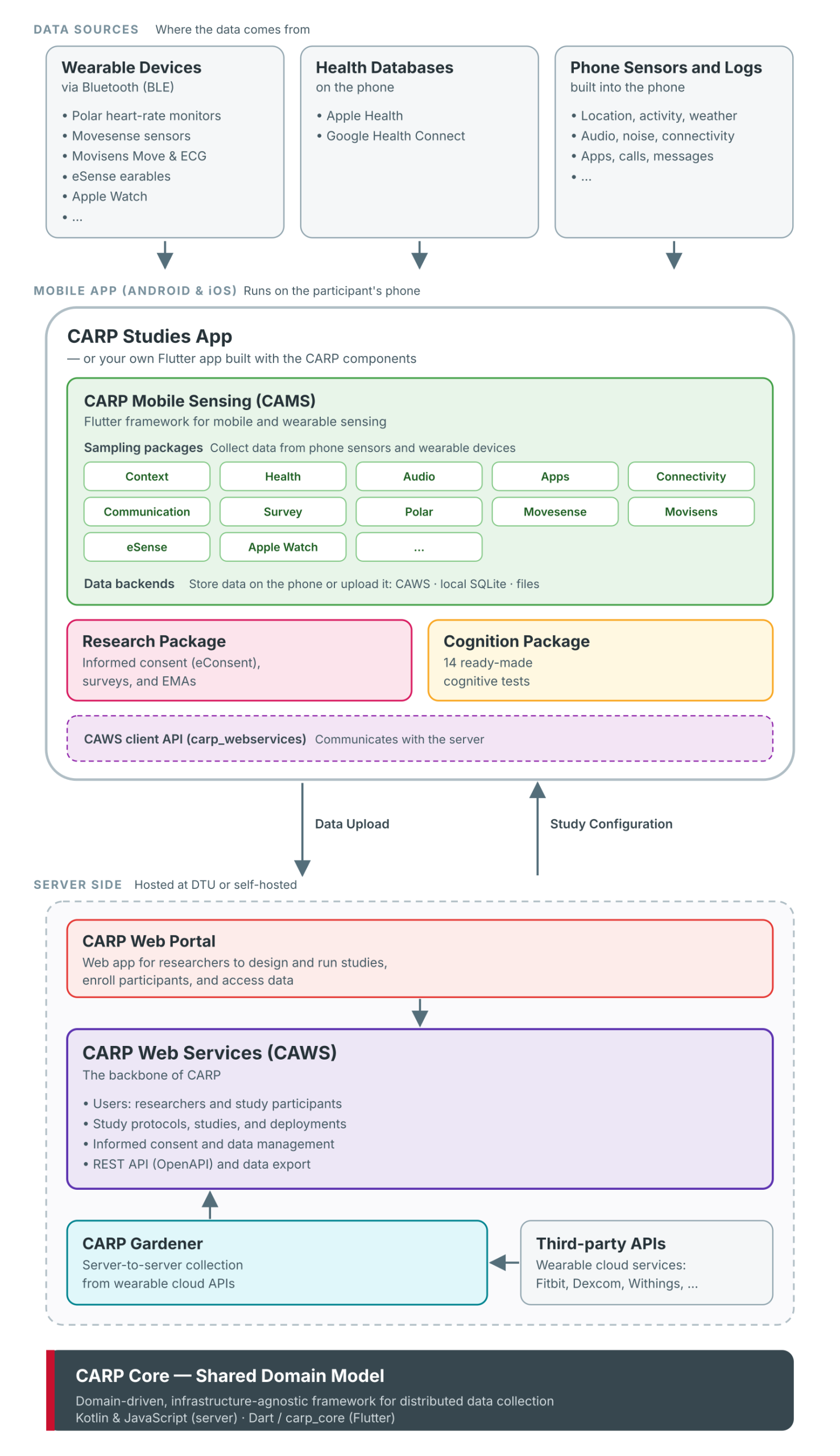
Figure 1 shows the overall architecture of CARP. The components are grouped into five families, described below. For each component, the name links to its page on carp.dk (where there is one), and the table links to its technical documentation on docs.carp.dk, its source code on GitHub, and its package on pub.dev or npm.
Domain Model
The domain model of CARP follows a domain-driven design (also known as the “onion” model or “clean architecture”) and is shared by all other components.
| Component | What it does | Docs | Source | Package |
|---|---|---|---|---|
| CARP Core | Infrastructure-agnostic framework and domain model for distributed data collection, written in Kotlin and compiled to JavaScript. | Docs | GitHub | – |
| carp_core | Dart implementation of the CARP Core domain model for Flutter apps. | Docs | GitHub | pub.dev |
Server-Side Infrastructure
The server side of CARP runs in the cloud, either as our hosted service at DTU or on your own servers.
| Component | What it does | Docs | Source | Package |
|---|---|---|---|---|
| CARP Web Services (CAWS) | Backend that handles users (researchers and study participants), study protocols, studies, and data management. CAWS is the backbone of CARP. | Docs | GitHub | – |
| CARP Web Portal | Web app for researchers to create, manage, and run studies, including enrolling participants. | – | GitHub | – |
| CARP Gardener | Collects data from other web services in a server-to-server setup, for example from the Fitbit or Dexcom APIs. | – | GitHub | – |
Client Libraries
Client libraries let apps communicate with CAWS.
| Component | What it does | Docs | Source | Package |
|---|---|---|---|---|
| carp_webservices | Dart/Flutter API for CAWS, used by Flutter apps to sign in, get study deployments, and upload data. | Docs | GitHub | pub.dev |
| @carp-dk/client | TypeScript API client for CAWS, used by web apps. | Docs | GitHub | npm |
Mobile and Wearable Sensing
CARP Mobile Sensing (CAMS) is a Flutter framework for building cross-platform (Android, iOS) mobile and wearable sensing apps for mobile health (mHealth). CAMS is embedded in domain-specific apps and adds sensing capabilities to them.
| Component | What it does | Docs | Source | Package |
|---|---|---|---|---|
| CARP Mobile Sensing (CAMS) | The core sensing framework, including data managers for storing data on the phone or uploading it to CAWS. | Docs | GitHub | pub.dev |
| Sampling packages | Add-on packages that collect data from phone sensors and wearable devices: Context, Health, Audio, Connectivity, Communication, Apps, Survey, Polar, Movesense, Movisens, eSense, Apple Watch. | Docs | GitHub | pub.dev |
User-Generated Data
These frameworks are embedded in apps to collect data from participants themselves. They are not end-user apps as such.
| Component | What it does | Docs | Source | Package |
|---|---|---|---|---|
| Research Package | Flutter implementation of Apple’s ResearchKit for informed consent (eConsent), surveys, and ecological momentary assessments (EMAs). | Docs | GitHub | pub.dev |
| Cognition Package | Framework for cognitive assessment on the phone, with 14 ready-made cognitive tests. | Docs | GitHub | pub.dev |
Applications
Several mHealth applications have been built using CARP. See the Applications page for an overview.
The following apps are open source. They work as demo apps and are useful as templates for building new apps:
| Component | What it does | Docs | Source | Package |
|---|---|---|---|---|
| CARP Studies App | App for running CARP studies, available for Android and iOS. | – | GitHub | – |
| CARP Mobile Sensing Demo App | Simple app demonstrating passive data collection with CAMS, including integration of wearable devices over Bluetooth. | – | GitHub | – |
| CARP Pulmonary Monitor | Simple app demonstrating the AppTask model for collecting user-generated data. | – | GitHub | – |